Red dawn & Blue dusk – How art changes people's everyday lives
About the artist Peter Stöcker
Peter Stöcker (born in Bremen in 1980) is an artist and designer. Under his pseudonym THECUT, he has been working for many years at the intersection of graphic design, painting, and urban space. His works are characterized by clear forms, geometric structures, and strong color contrasts, which often enter into dialogue with architecture. In addition to his freelance artistic work, he founded the urban art agency Lucky Walls, through which he initiates and implements projects in public spaces.
Stöcker describes his own style as “monumomentum.” His works are about progress, transformation, and energy. Visualizing these energies and creating a monument to them is a central aspect of his artistic expression. In his tunnel design, he takes up the existing energy of the flow of people, transforms it into graphic compositions, and thus creates a clearly visible sign. The work enhances the location, emphasizes its energy, and transforms a space that previously had rather negative connotations into a public space with a positive presence and aura.

The artistic concept
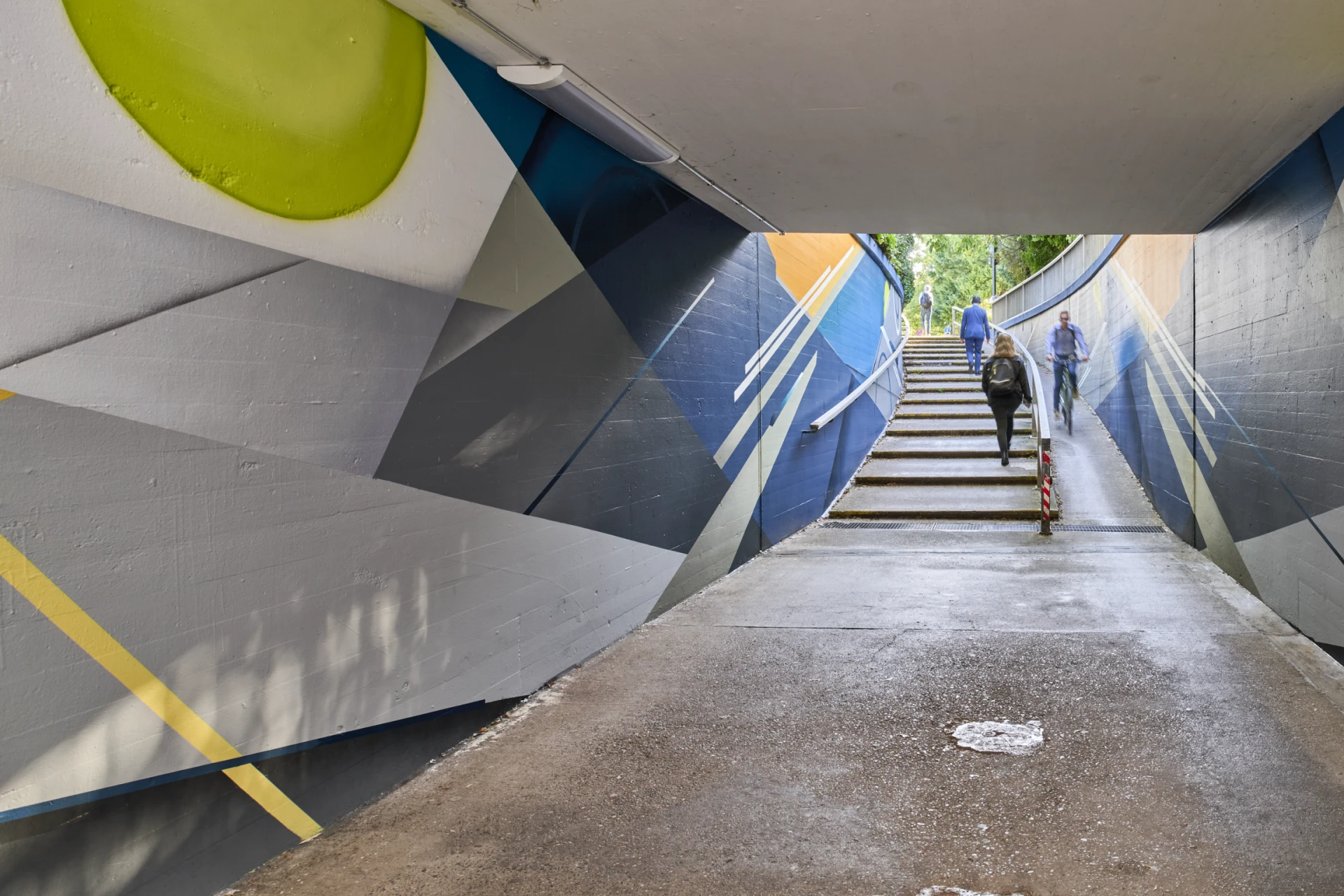
For the design of “Morgenrot & Abendblau” (“Red Dawn & Blue Evening”), Stöcker abstracted the dynamics of daily commuter flows. Every morning, people rush to work, and in the evening they return home—a rhythm that defines the train station and its surroundings. He translated this constant movement into lines, circles, and surfaces, merging it with the tunnel spaces. In doing so, the people themselves become part of the artwork: their movements through the tunnels are reflected in the composition, giving the work additional energy and dynamism. Those who enter the underpasses not only experience a work of art, but also become an active part of the visual flow.
The unique situation on site
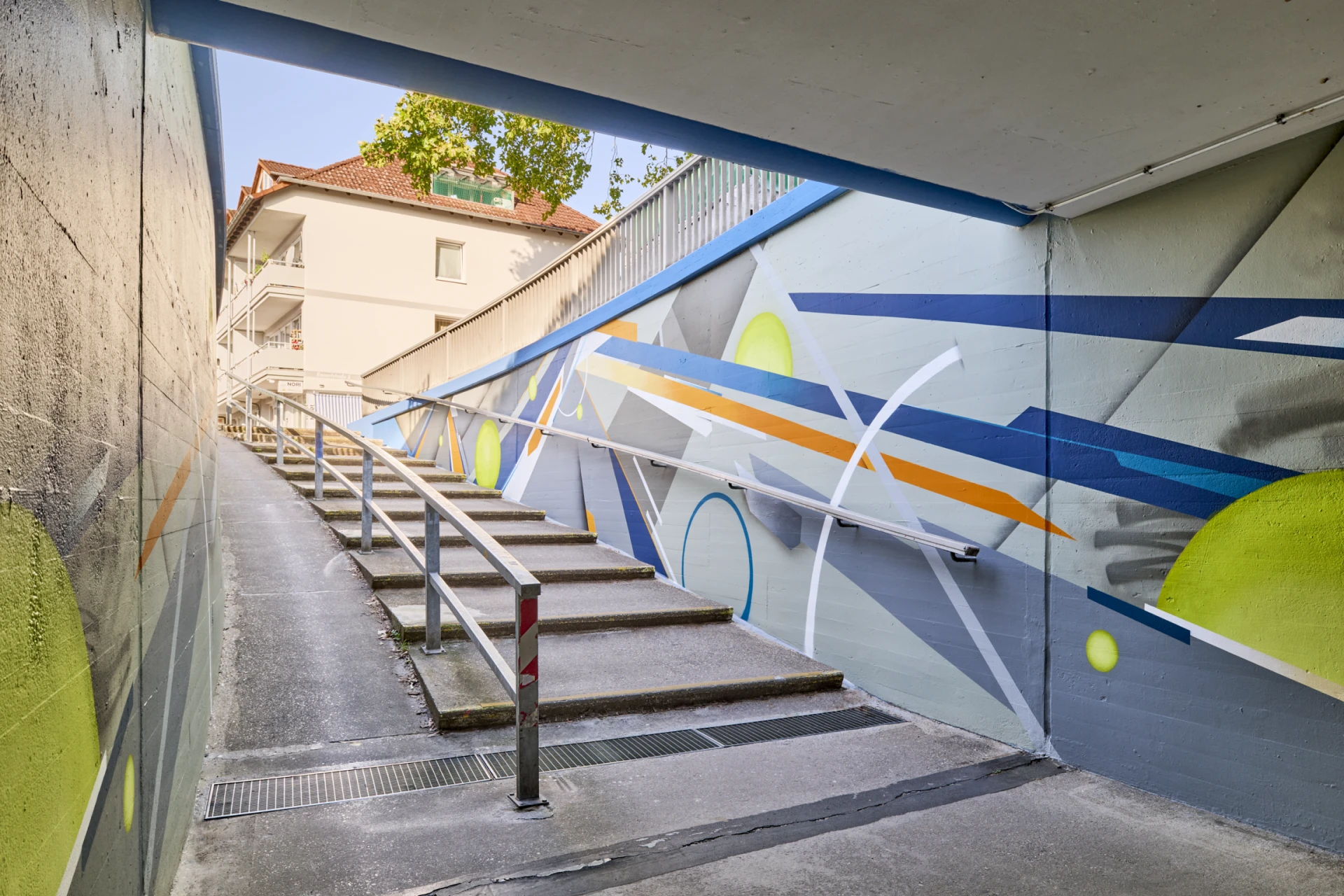
The two tunnels are located on the same axis and follow one after the other. “Abendblau” passes under an expressway, which is separated from the surrounding area by noise barriers. After about 150 meters, past the bicycle stand and toilet container, the second tunnel, “Morgenrot,” opens up, leading directly to the S-Bahn station or into an adjacent residential area.
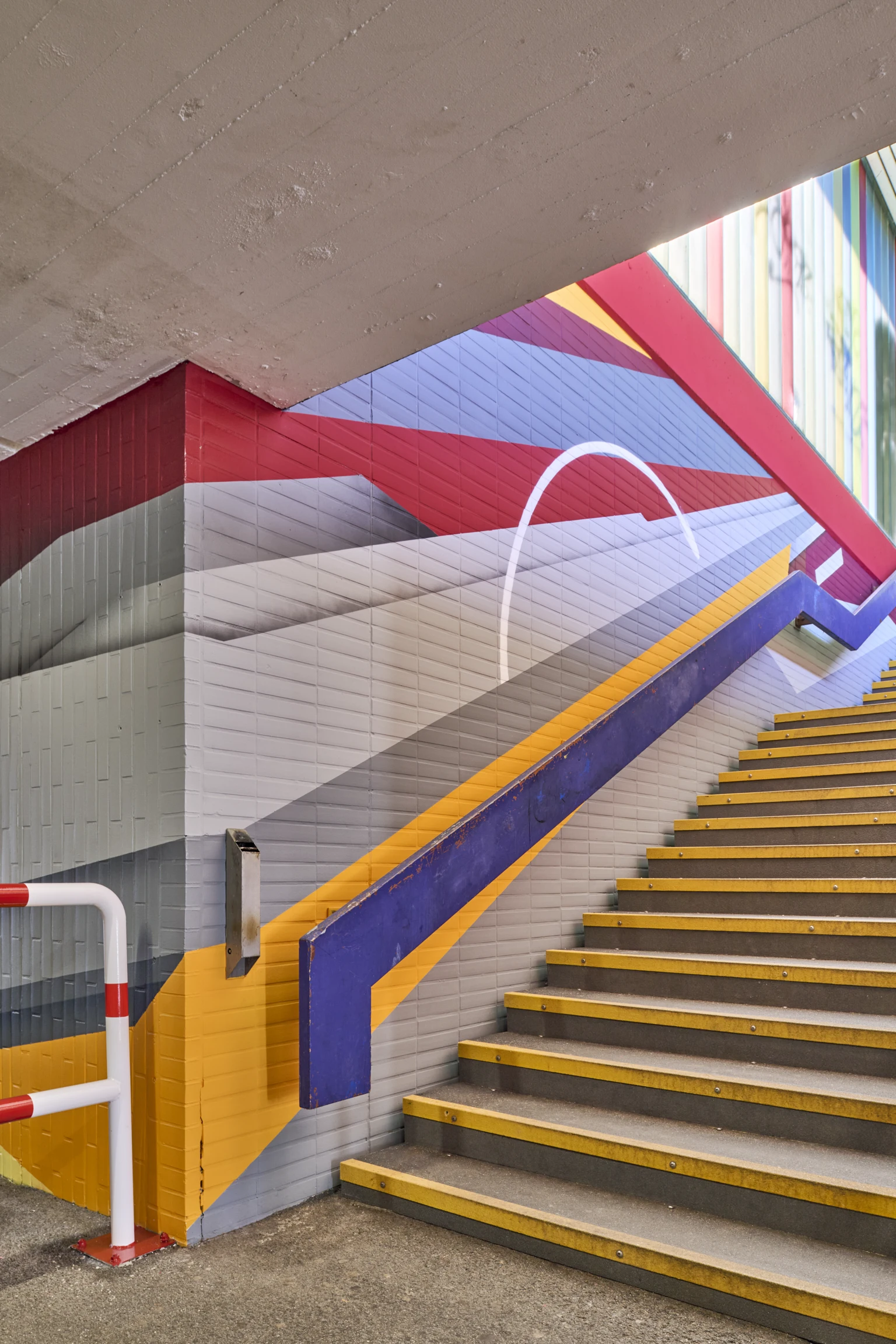
Particularly impressive is the staircase to the S-Bahn, which interrupts the linear direction of the tunnel and creates a crossing axis of movement. This is also reflected in the design: in the tunnel, the lines and shapes change direction several times to reflect the dynamics of the different directions of movement. Coming from the S-Bahn, the designs of the tunnel and staircase merge and gently guide passengers into the tunnel. Another exciting detail is the colorful opaque window at the top of the staircase, whose colors and shapes are echoed in the design of the toilet container, creating a visual connection beyond the tunnel.
Transformation of space and perception
Prior to the artistic intervention, the tunnels were considered dark, narrow, and uninviting. Pedestrian tunnels and train stations often have a poor reputation, so people rarely spend time there and sometimes feel unsafe. The design of “Morgenrot & Abendblau” does not physically change the location, but it creates a positive, pleasant atmosphere that invites people to linger and fundamentally changes their perception.
It is particularly interesting that the abstraction of the commuters' movements makes the people themselves part of the change. Their movements merge with the composition, giving the work additional energy and dynamism. During the on-site documentation, it became clear on several occasions how strongly this effect is perceived: People walking by talked to me, complimented the design, and were enthusiastic about the fact that the tunnels now radiate positive energy. The artwork has thus not only visually enhanced the space, but also had a lasting impact on people's experience and mood.
Collaboration and impact
The project was realized in close cooperation with the city of Eschborn and Lucky Walls. It exemplifies the impact that urban art can have: it not only enriches the visual appearance of a place, but also changes people's perceptions, moods, and behavior. For commuters who pass through the tunnels every day, this significantly enhances their daily routine. Art becomes an integral part of their daily journey and creates a place of experience and inspiration.
