Photographing tall buildings in the city illustrated by the example of FOUR Frankfurt
1. Perspective and location
The location is probably the easiest aspect to control when it comes to capturing a building in its entirety. With more distance, we have more space to choose a beautiful composition. What sounds simple at first often isn't that easy at all. With narrow streets and surrounding buildings, we first have to find the perfect spots.
That’s why location scouting is a necessary part of the preparation for every high-rise project we photograph. This means walking through the neighborhood and keeping our eyes open for places where the building stands out beautifully. Parking garages and rooftop terraces are particularly helpful here, as they provide us with an elevated viewing point. It’s important, however, to respect the rights of property owners and ask for permission accordingly.
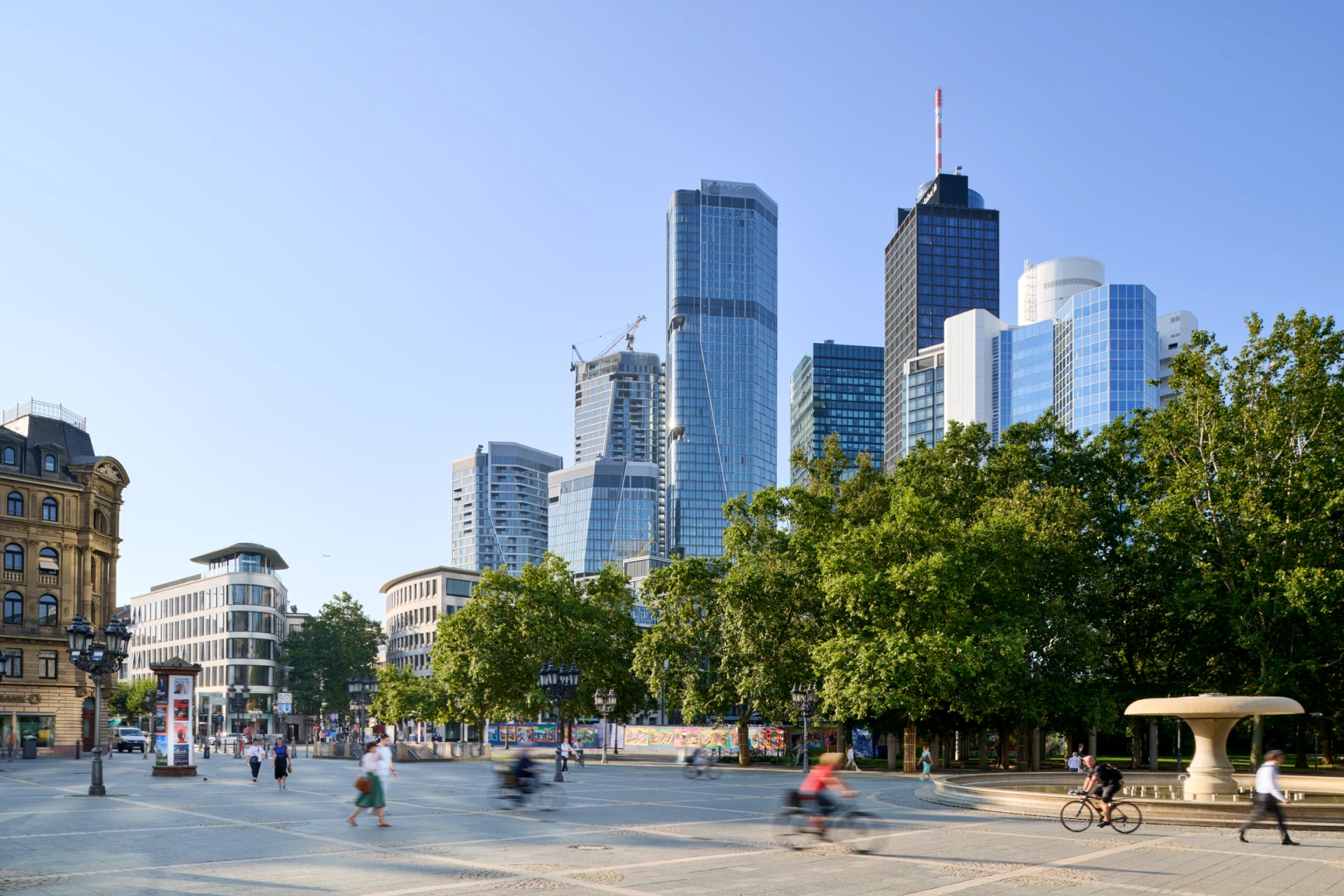
Even though the search for locations involves a lot of effort, this is often how we get the best shots. One crucial factor plays a key role here: context. In addition to the documentary depiction of a building, it’s just as important to place it in relation to its urban surroundings. In the case of FOUR Frankfurt, this allowed us to highlight its imposing presence and charisma, which extend far beyond the banking district. During the shoot, we covered a lot of steps and explored various perspectives: from Gallusanlage and Opernplatz all the way to a parking deck. FOUR Frankfurt stands out from every angle, yet it also blends seamlessly into the thriving cityscape.

2. Lens selection and focal length
When photographing tall buildings, wide angles are generally needed to capture the entire structure. For exterior shots, we therefore most often use a 19mm or 24mm lens. By using special tilt-shift lenses, we gain even more creative freedom and can avoid unwanted converging lines.
Tilt-shift lenses have an image circle larger than the size of the camera sensor. A mechanical mechanism allows the lens—and thus the image circle—to be shifted, bringing elements that were initially outside the frame into the image. This lets us actively compose the image without altering the perspective.
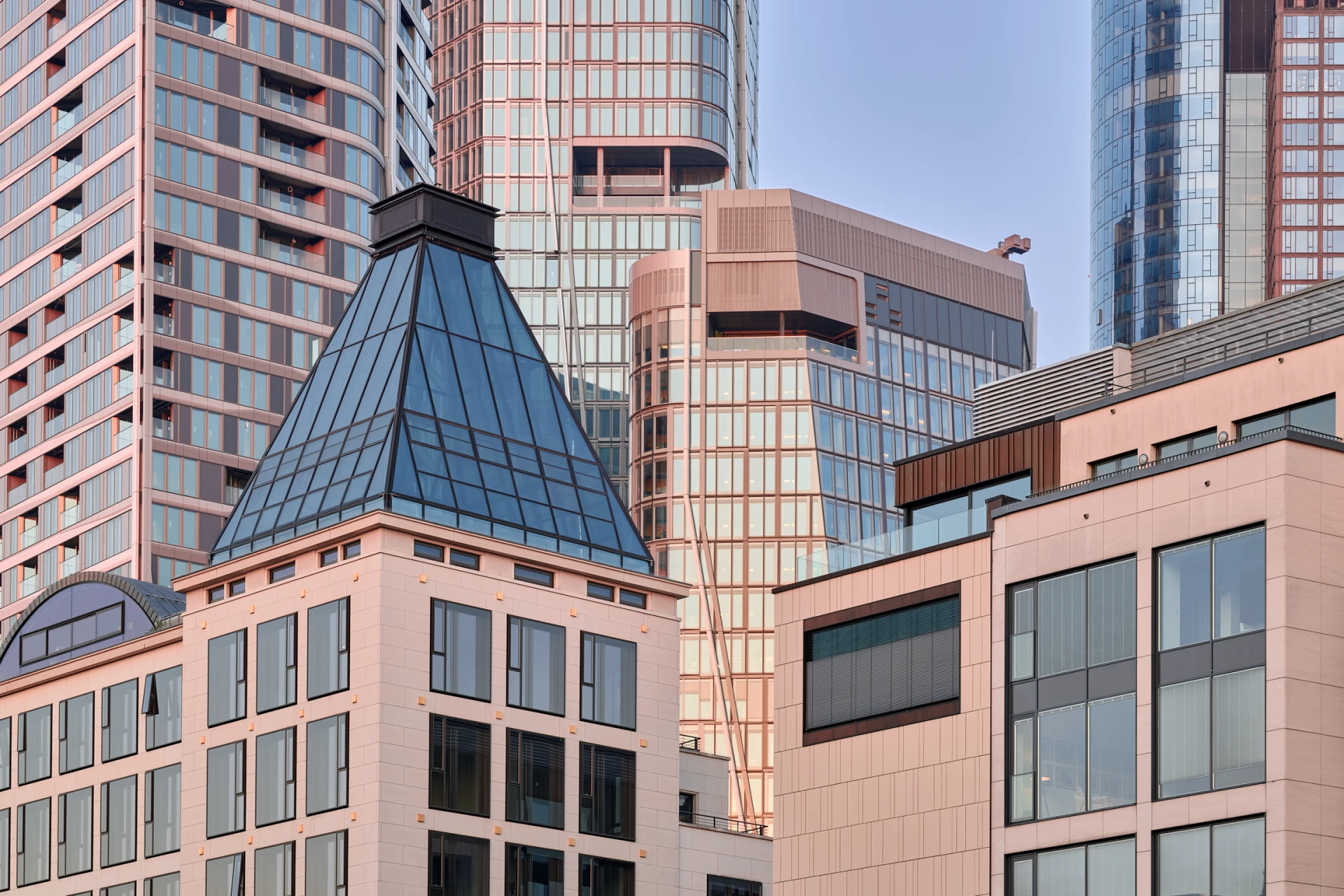
Longer focal lengths can also be deliberately used for photographing tall buildings in urban settings. They are particularly well-suited for detailed shots. However, they can also be used to make an image feel more compact and to place greater attention on the building, while the surroundings are shifted into the blur of the foreground.
3. Light and daytime
Light has a central role in architectural photography. It creates tension, sets the mood, and highlights key elements. Warm sunlight in the early morning and evening, or a brightly lit glass facade contrasting with the darkness of the blue hour, are particularly popular lighting conditions.
However, the rest of the day is also important. After all, we want to document a project as comprehensively as possible and at various times of day. The sun’s position therefore plays a major role in projects set in densely built-up downtown areas and must be taken into account during preparation. Surrounding buildings can cast unwanted shadows, just as the sun can shine light onto the facade between buildings at certain times. To better prepare for a shoot, we like to use planning apps such as www.shademap.app to estimate the sun’s position and shadow patterns in advance.

4. Compositions
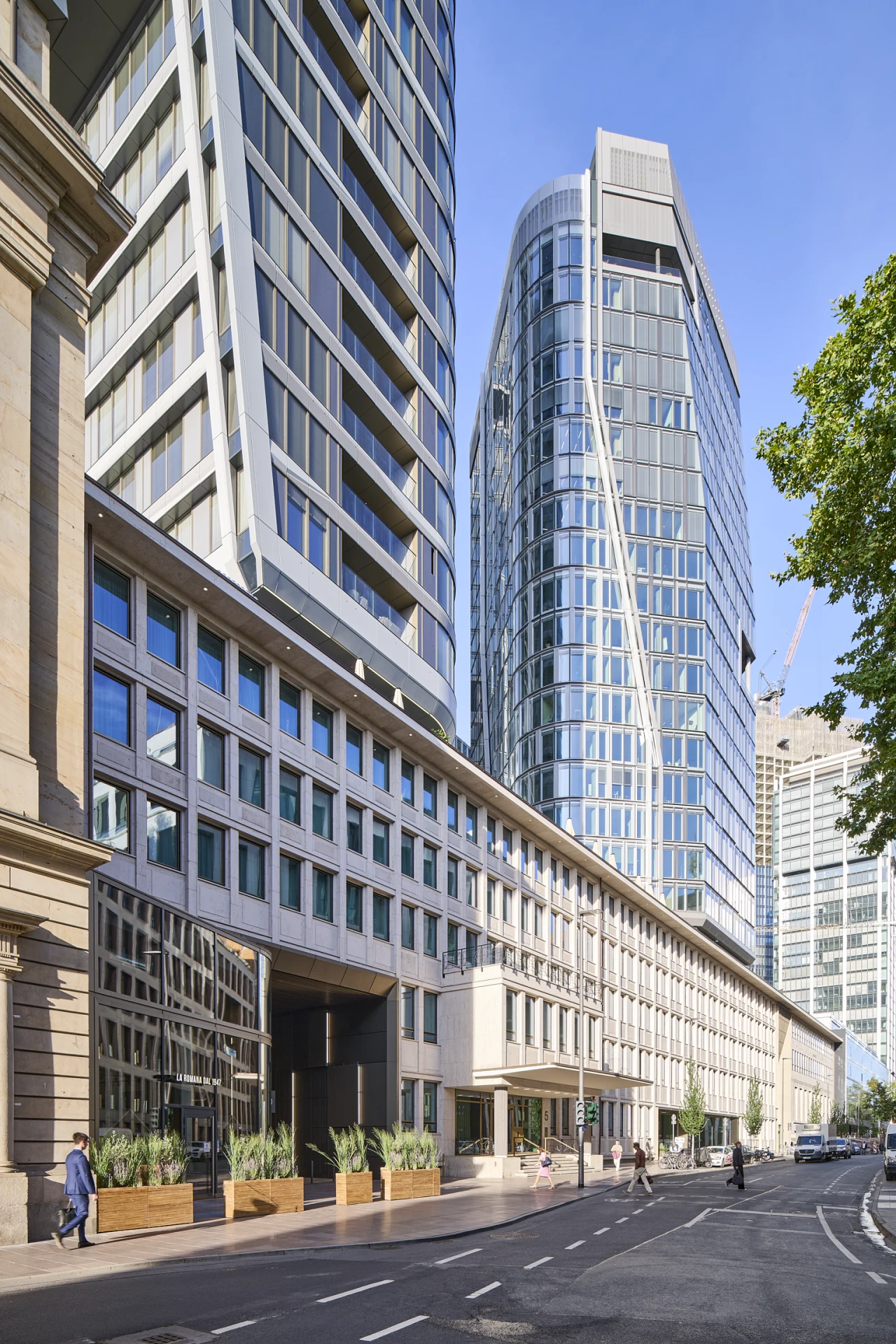
A clear composition is crucial for depicting a building objectively and guiding the viewer’s gaze. Dramatic converging lines are generally counterproductive in this case and should be avoided. Symmetry, on the other hand, creates a calming effect because it gives the image a clear and simple structure. It is particularly well-suited for depicting the proportions of a building’s architecture. Oblique perspectives and asymmetrical compositions are especially helpful in narrow streets. They make it possible to capture a building dynamically, create interesting lines, and make creative use of the limited space.
5. Incorporate the life of the city
As already described at the beginning in the section about selecting a location, it is important to incorporate external influences to ensure that architectural photographs are expressive and compelling. Architecture is not an anonymous sculpture in the city. It is part of a living environment and shapes it both aesthetically and functionally. Therefore, in our view, it is particularly important to include people. This applies both to creating vibrant images and to the functional context of the architecture.
However, the surroundings often contain distracting elements such as construction sites, large parked vans, or other disruptive objects. In these moments, creativity is key: changing perspectives, shifting vantage points, or consciously and tastefully integrating the distracting elements into the frame. Those who learn to work with the given conditions can transform even unexpected distractions into an asset for the photograph.

Conclusion
Photographing tall buildings in the city presents a challenge at first. However, these challenges motivate us and encourage us to approach the project creatively and find solutions. At its core, architectural photography requires a conscious engagement with buildings and spaces. Thanks to our experience, the right equipment, and our ability to find creative solutions, we can confidently capture any building.
While documenting the FOUR Frankfurt, we faced a variety of challenges in many different situations. As a result of this intensive engagement, however, many beautiful and exciting perspectives emerged that do justice to the project’s enormous presence. From many angles across the city, the four towers can be seen rising between the buildings and now define the imposing skyline. If you’re interested in learning more about the project, you can discover additional photos on the project page at xxx.