Fröhliche Weihnachten 2025!
Motiv: „Winterbild in drei Formen“
Das Motiv mit dem Titel „Winterbild in drei Formen“ zeigt, wie der Titel bereits verrät, eine abstrahierte Winterlandschaft, konstruiert aus den geometrischen Formen Kreis, Dreieck und Rechteck. Die Komposition der Formen ruht auf dem Fundament des Goldenen Schnitts, wird jedoch durch eine asymmetrische Anordnung bewusst konterkariert. Auffällig ist zudem die freischwingende Linie, die sich an die Geometrie des Bildes anschmiegt und den Himmel vom Horizont trennt.
Die Farbgebung des Bildes lebt vom Kontrast zwischen einem tiefen Blau und einem warmen Gelb, das aus dem Inneren des angedeuteten Hauses sowie am Horizont erstrahlt. Dahinter liegen zwei stille Tannen in einer gemischten Grüntönung. Ein wesentlicher Einfluss auf die Komposition stammt aus der Lehre Wassily Kandinskys, insbesondere aus der Auseinandersetzung mit seinem Schriftwerk „Punkt und Linie zu Fläche“ aus dem Jahr 1926, mit der ich mich kürzlich befasst habe.
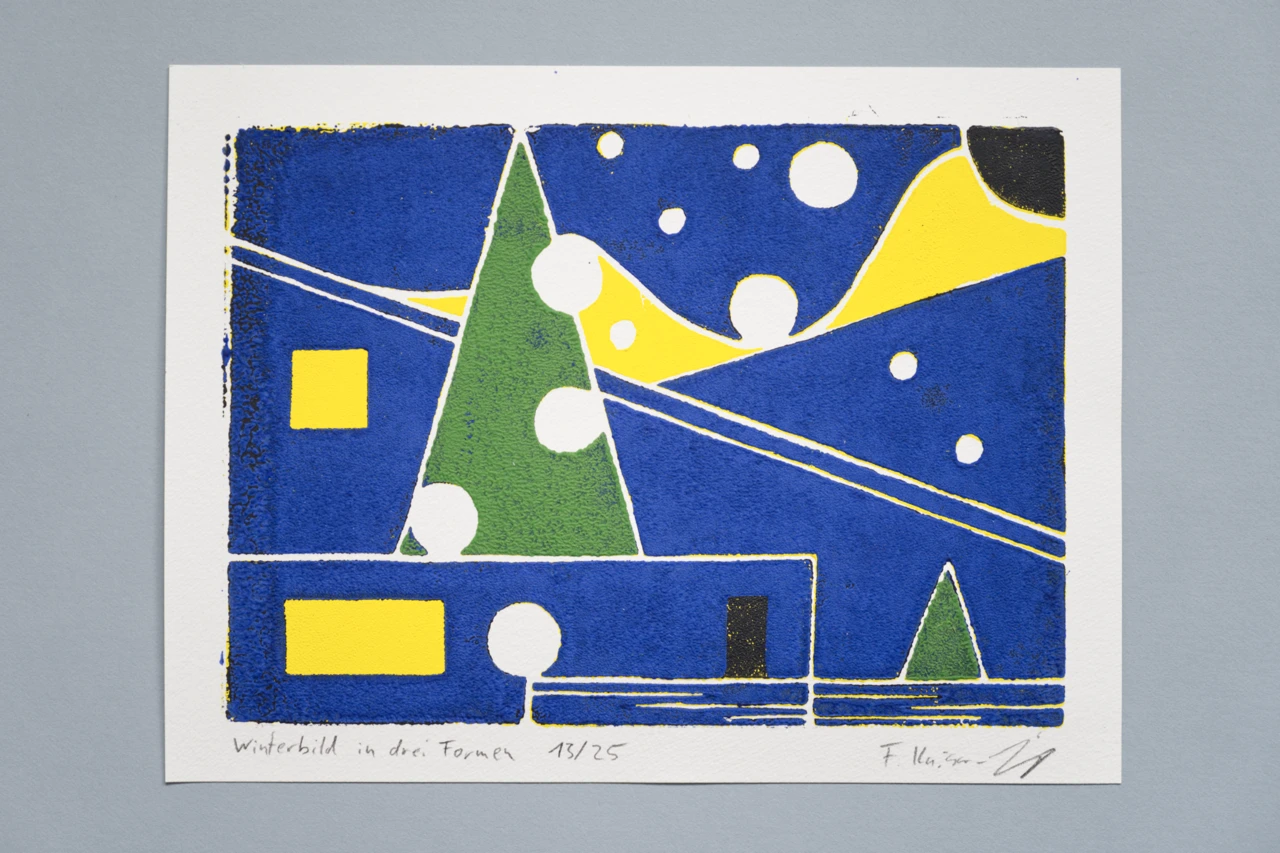

Drucktechnik: Linolschnitt - Reduktionsdruck
Als Druckverfahren habe ich einen Linolschnitt gewählt, da sich Linoleum gut in Handarbeit bearbeiten lässt. Um die Auflage möglichst exklusiv zu halten, entschied ich mich für das spezielle Verfahren des Reduktionsdrucks, das auch von Picasso gerne verwendet wurde.
Beim Reduktionsdruck wird mit einer einzigen Druckplatte gearbeitet, die mit jeder Farbschicht kontinuierlich weiter abgetragen wird. Auf diese Weise verändert sich die Druckplatte permanent und kann nicht wiederverwendet werden. Das Nachdrucken weiterer Exemplare ist nur in einer neuen Auflage mit neu geschnitzter Druckplatte möglich. Das Verfahren erfordert eine sehr präzise Planung der einzelnen Schichten, da die Farben übereinander gedruckt werden. Die Reihenfolge der Schichten und des Abtragens der Platte entscheidet darüber, welche Bereiche am Ende in welcher Farbe sichtbar sind. Zudem muss möglichst exakt gearbeitet werden, damit alle Schichten deckungsgleich gedruckt werden. Das Motiv „Winterbild in drei Formen“ wurde in vier Schichten gedruckt.
Produktionsprozess: Von der Skizze zum Kunstdruck
Von der ersten Skizze bis zum fertigen Kunstdruck führte ein Weg aus vielen Arbeitsschritten, der sich über mehrere Wochen zog. Zu Beginn entstand mit Bleistift und Geodreieck der Entwurf. Dafür schnitt ich mir ein Blatt Papier im gewünschten Endformat zu und experimentierte mit der Anordnung von Kreisen, Dreiecken und Rechtecken zueinander. Als erste Elemente entstanden die Rechtecke, die das angeschnittene Haus andeuten (Mir war es wichtig, einen Bezug zur Architektur herzustellen). Nach und nach baute sich das Motiv weiter auf. Ich fügte neue Elemente hinzu und entfernte andere wieder, bis ein harmonisches Bild vor mir lag, das sich stimmig anfühlte. Anschließend ging es darum, eine passende Farbgebung zu finden. Mit Buntstiften und digital probierte ich verschiedene Farbschemata aus und entschied mich schließlich für eine reduzierte Farbwelt aus Blau und Gelb (Ebenfalls Grundfarben aus der Lehre des Bauhauses). Die Farbe Grün fügte ich erst später hinzu, um dem Bild zusätzliche Tiefe und Ruhe zu verleihen.
Darauf folgte der handwerkliche Prozess des Druckens. Zunächst übertrug ich die Skizze spiegelverkehrt auf die Linol-Druckplatte. Dazu übermalte ich das Blatt mit Pastellkreide und zeichnete die Linien auf der Rückseite nach. Anschließend begannen die ersten Schnitzarbeiten für die weißen Stellen, an denen keine Farbe gedruckt werden sollte. Hierzu nutzte ich ein Schnittwerkzeug, um die feinen Linien vorsichtig in die Platte zu schnitzen. Nachdem die Platte vorbereitet war, baute ich eine Druckvorrichtung mit gleicher Höhe wie die Druckplatte, damit das Papier beim Druck nicht knickt. Mithilfe eines Anschlags in der Größe des Papiers stellte ich sicher, dass alle Blätter gleich positioniert gedruckt werden konnten. Anschließend begann der eigentliche Druckprozess. Dazu verteilte ich die leicht zähflüssige Linoldruckfarbe auf einer Glasplatte und trug eine gleichmäßige Farbschicht auf die Druckplatte auf. Danach wurde die Platte in die Vorrichtung gelegt und das Papier aufgelegt. Mit einem Tuch drückte ich das Papier gleichmäßig an und zog es vorsichtig wieder ab. Dieser Prozess wurde für jede Schicht wiederholt, jeweils mit einem Tag Trockenzeit dazwischen. Gedruckt wurde das Bild in der Reihenfolge Gelb, Schwarz, Blau und Grün. Den Abschluss bildeten die Signierung, Nummerierung und Beschriftung der Drucke.


Kunstdruck: Florian Kaiser-Winter „Winterbild in drei Formen“, 2025
Der Kunstdruck „Winterbild in drei Formen“ (2025) wurde mit Aqua-Linolfarbe auf Gummiarabikum-Basis in Handarbeit auf einem 300 g/m² Hahnemühle-Papier gedruckt. Das Papierformat beträgt 18 cm × 24 cm. Der Druckbereich misst 15 cm × 21 cm und ist von einem umlaufenden Rand von 1,5 cm eingefasst. Die Auflage ist auf 25 nummerierte und handsignierte Exemplare limitiert.