Benrather Straße Metro Station – Thomas Stricker “Himmel oben, Himmel unten”
Architecture far away from space and time
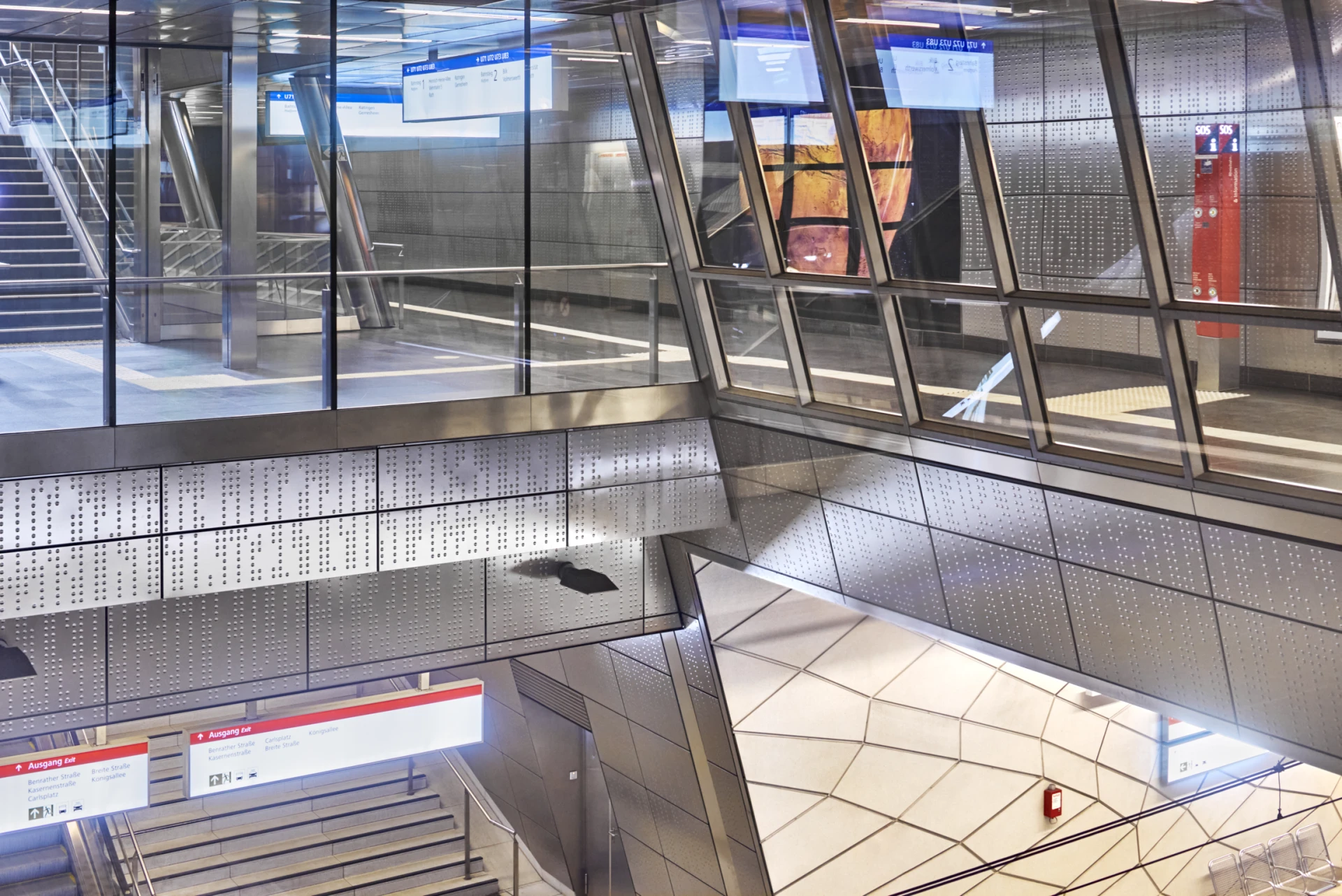
We slowly descend the escalator between the canyon of houses on Benrather Straße. Beside us is a nub-like structure made of shiny stainless steel. It is reminiscent of Braille, which assigns a letter to a raised dot pattern through its relief. Is there a message written on the wall that we cannot decipher? After a third of the way down, the station room begins to open up. Once on the distribution level, we look through a glass box into the elongated station room. Underneath the box, we can see directly onto the tracks. The walls are covered in studded stainless steel, creating a cool and sterile atmosphere. Then suddenly, out of the corner of our eye, we see a huge ball of fire pass by.
A metro station becomes a time capsule
In his work “Himmel oben, Himmel unten,” Thomas Stricker takes us on a journey into another cosmos. He plays with our expectations of a metro station and reverses them into a fantasy world that we otherwise only know from television. However, it would be a mistake to limit the artistic concept merely to the game of reversing relations. The meaning weighs far more heavily than the reversal of a firmly defined norm. With the reversal of above and below, the rest of the time-space structure is consequently reversed as well. The space beneath the earth becomes weightless, and time passes at a different rhythm. “Himmel oben, Himmel unten” creates a time capsule in which passengers can escape the pulse of the city. After descending into the depths, they find themselves in a place far removed from the world they were in seconds before. They are now in a space where time is not defined, where they can block out everyday life. Everyday life lies far away on Earth, which occasionally flashes past on the monitors, like windows within the walls.

A spaceship hidden beneath the streets of the city
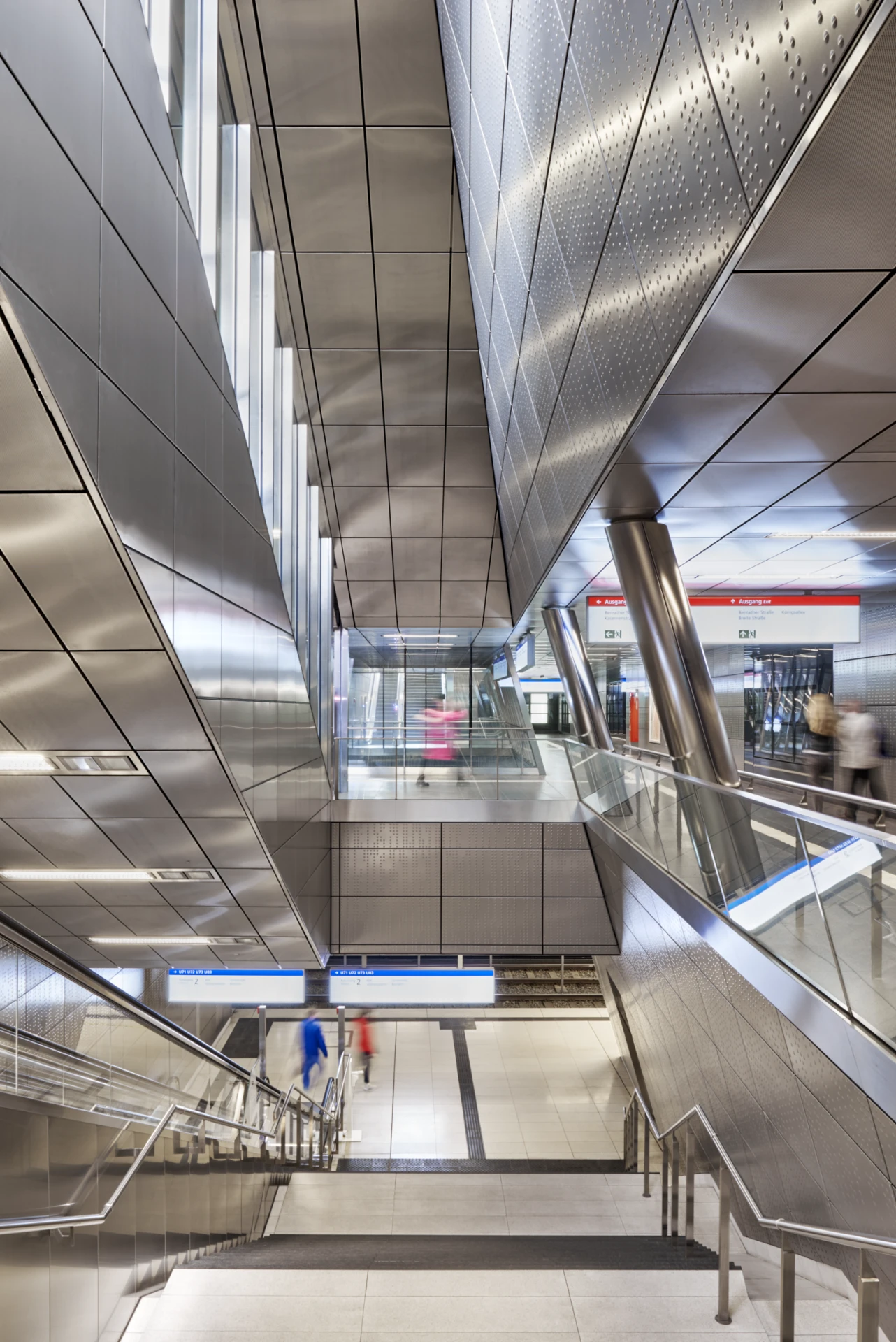
Thomas Stricker’s artistic intervention transforms the space cut into the ground into a spaceship traveling in a loop through our solar system. However, the architecture, which was developed in intensive dialogue with the Darmstadt-based planners Netzwerkarchitekten, is decisive for this illusion. The futuristic lines of the building elements and the central airspace above the railway tracks make the vision of the spaceship a reality. In the center of the distribution level, passengers stand on the command bridge and have an overview of the trains arriving and departing below them. If they look around, they can see the entire space and watch the planets and stars pass by. This perception of space is made possible by the generous glass surfaces, which also create a direct connection between Earth’s surface and the track level. The wedge-shaped airspace running parallel to the staircase extends to the tracks and minimizes the separation of functional levels. The result of the open design is a feeling of freedom and weightlessness. Just as we would expect from a space station.
A symbiosis of art and architecture
The station’s sterile, satin-finish lining of studded stainless steel consistently separates the space from the surrounding ground and eliminates any awareness of its subterranean existence. In a unity of architecture and artistic installation, a place is created whose existence seems impossible. In a densely built-up city, a space of infinity suddenly opens up and stops time for as long as one lingers. The Benrather Straße station space is thus not only an aesthetic spatial creation, but also a space of imagination for tens of thousands of commuters every day.
Architectural photography between time and space
In my work as an architectural photographer, photographing this metro station was a challenge. The metal paneling of the station space creates a symbiosis between the artwork and the architecture that makes it almost impossible to separate them from one another through the choice of perspective or framing. As the architecture creates the imaginary space for the spaceship, I have documented the station as a unit. In my pictures, I show the important architectural elements such as staircases, airspaces, or elevator shafts. At the same time, the choice of orthogonal angles emphasizes the vision of the artistic concept and supports the sharp-edged nature of the architecture. You can see for yourself on the “Benrather Straße Metro Station” project page.